FIELD REVIEW / Action adventure
Hyper Light Drifter
A visually forceful adventure for players comfortable with demanding fights and unexplained discoveries. Fast movement and limited explanation make this a good match for players comfortable learning through observation.
Game facts
- Developer
- Heart Machine
- Publisher
- Heart Machine
- Released
- 31 March 2016
- Platforms
- Windows · macOS · Linux (Steam edition)
- Model
- Paid game
- PEGI
- 12 — Nintendo Switch Special Edition edition; not a separate PC classification
- Players
- Single-player · Multi-player · Shared/Split Screen PvP · Co-op · Shared/Split Screen Co-op
- Length
- Short
- Difficulty
- 4 / 5 · Challenging
- Steam Deck
- Verified
PEGI source ↗ · Steam Deck status source ↗
Edition: Base game
The score, explained
The interest and responsiveness of the core decisions and actions.
How progression, exploration and goals fit together.
The coherence of the visual, musical and narrative presentation.
How clearly the game explains its rules and offers useful ways to engage.
The depth of optional goals, alternative approaches and reasons to return.
Danger is part of the exploration
Hyper Light Drifter follows an ill traveller through a ruined world of lost technology and violent history. The published design combines weapon upgrades, new skills, equipment discoveries and branching routes, with enemies and hazards that can quickly punish a mistake. That places exploration and combat in a productive tension: a promising path also means another encounter that must be understood. The core concept works through making movement through the world feel consequential without relying on a large party or an extensive dialogue system. The same emphasis limits the audience. Someone who wants to inspect the scenery with very little interruption may find the dangers too central, while a player who likes discoveries to be earned through action has a clearer reason to engage.
Finding a route without a long explanation
The ruined setting and the Drifter's search create a direction, but the appeal lies in piecing together a place whose history is not delivered as a straightforward itinerary. Branching paths and hidden equipment give practical value to attention, while upgrades can change how earlier obstacles are approached. Our clarity score is intentionally lower than the presentation score because this style of adventure asks the player to tolerate uncertainty. That is a design preference, not a defect that disappears when the artwork is attractive. It helps to enjoy remembering landmarks and making small investigations without immediate confirmation that each one matters. Readers who want objectives to explain their importance before setting out should consider a more explicit adventure such as Death's Door.
A vivid ruin rather than a neutral backdrop
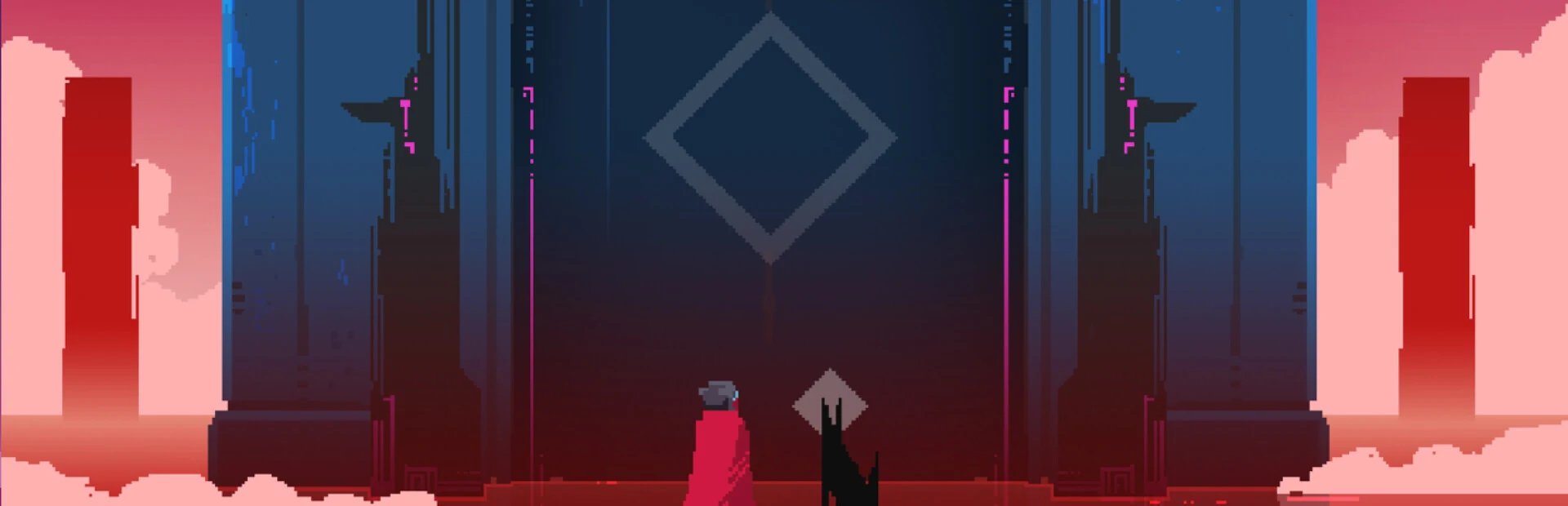
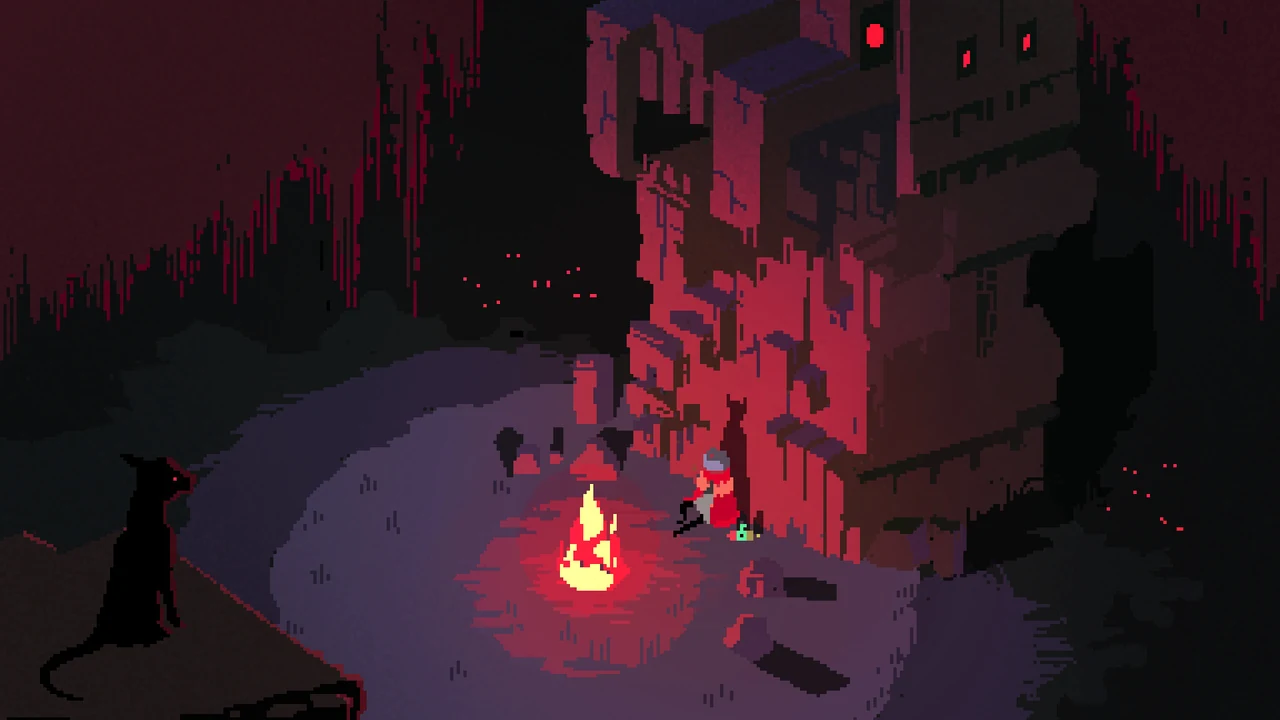
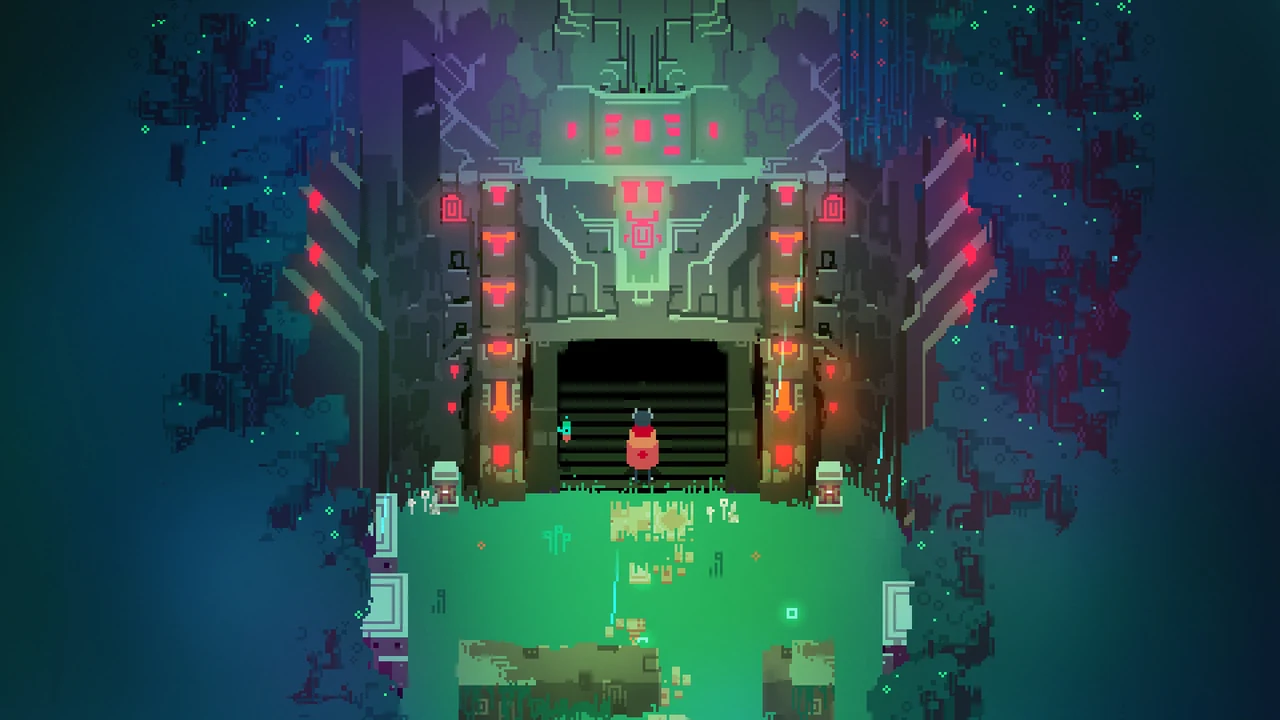
The official imagery gives Hyper Light Drifter a striking contrast between bright colour and damaged surroundings. Hand-animated characters and environmental details make the world feel designed at several scales, from an individual figure to a distant structure. That matters in an adventure where images carry much of the invitation to explore: a place needs to be memorable even before its purpose becomes clear. We see the presentation as one of the strongest reasons to choose the game, because it supports curiosity without making the setting comfortable or safe. Bright effects and stark colour contrasts give a dash or attack a strong visual presence, while the surrounding ruins provide quieter spaces in which to notice the world's strange details.
For players who accept the unknown
Hyper Light Drifter makes most sense when the combination of demanding action and an incompletely explained world sounds appealing in itself. Weapon development and discoveries provide reasons to revisit spaces, but the game should not be chosen as a substitute for a dialogue-heavy role-playing epic. Its strength is a concentrated relationship between the traveller, their abilities and an inhospitable landscape. Our return score reflects the available branching routes and equipment secrets rather than an assumption that everyone will want another complete journey. Death's Door offers a helpful alternative within this catalogue: it also centres dangerous exploration, but its soul-collecting job and dark humour provide a more explicit narrative frame. Choose the Drifter when interpreting the world is part of the challenge you want. Fast movement and limited explanation make this a good match for players comfortable learning through observation.
The verdict
A visually forceful adventure for players comfortable with demanding fights and unexplained discoveries. Fast movement and limited explanation make this a good match for players comfortable learning through observation.
Reasons to play
- Strong visual identity makes the ruined world distinctive
- Branching paths connect exploration with equipment discoveries
- Combat and environmental danger reinforce vulnerability
Reasons to think twice
- Oblique presentation gives limited direct guidance
- Demanding encounters can interrupt exploratory momentum
See the game
Assist & accessibility
Explore the available settings and control options on the official game page before choosing your setup.
Parents’ guide
Players: Single-player · Multi-player · Shared/Split Screen PvP · Co-op · Shared/Split Screen Co-op. No in-game purchase marker in the checked Steam listing. Separate downloadable content may be sold.
Age classification: 12. Nintendo Switch Special Edition edition; not a separate PC classification
A useful starting tip
Record a blocked route or suspicious landmark before moving on, so a later upgrade has an obvious place to investigate.
A different direction
Compare this with Sekiro: Shadows Die Twice - GOTY Edition: A demanding action game whose posture system makes deflection, pressure and enemy knowledge more important than collecting better equipment. Posture pressure rewards staying engaged with an opponent instead of relying on a larger equipment collection.
Official sources
Reviewed: November 2026
You might also like
 Sekiro: Shadows Die Twice - GOTY EditionRead review →
 HadesRead review →
 CelesteRead review →